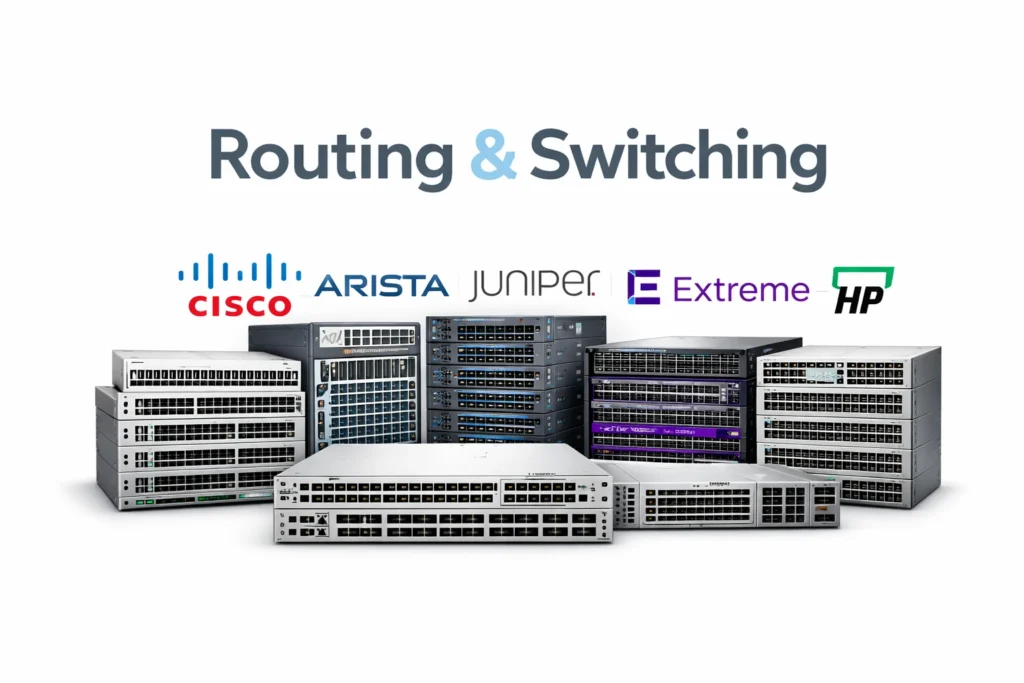
Routing and Switching form the core foundation of modern enterprise connectivity—enabling reliable communication between users, applications, datacenters, and cloud services. A well-architected routing and switching design prioritizes resiliency, performance, security, and operational simplicity through standardized topology, consistent IP addressing and segmentation, deterministic routing behavior, and robust Layer 2/Layer 3 controls. This foundation is essential for maintaining uptime, reducing latency, supporting growth, and ensuring predictable change outcomes

Business-driven design — Align availability, latency, and growth targets to application and SLA needs.
Modular architecture — Core/Distribution/Access or Leaf-Spine with clear roles and fault domains.
Resiliency by design — Redundancy, fast convergence, and proven failover (N+1, dual-homing, HA pairs).
Layer 2 containment — Minimize L2 blast radius; prefer L3 to the edge where practical.
Segmentation strategy — VRFs/VLANs, policy boundaries, and controlled inter-VRF routing.
Routing policy & control — OSPF/BGP design, summarization, filtering, and deterministic path selection.
High availability switching — MLAG/vPC, port-channels, and consistent STP strategy (or STP avoidance).
Addressing & summarization plan — Hierarchical IP plan enabling aggregation and simpler operations.
QoS end-to-end — Classification/marking at the edge, queuing in the core, and WAN consistency.
Security foundations — Secure management plane, control-plane protection, and hardening baselines.
Observability & telemetry — Streaming telemetry, NetFlow/sFlow, syslog, SNMP, and actionable dashboards.
Operational excellence — Standard templates, automation/version control, documentation, and lifecycle planning (upgrades, testing, rollback).
We deliver proactive, reliable, and secure IT solutions tailored to your business needs. Our experts monitor, manage, and optimize your infrastructure around the clock.
© All Copyright 2024 by Ovatheme.com
WhatsApp us